
Why Do Scammers Pretend to Be Your Web Designer?
Why do scammers pretend to be your web designer?
Because most business owners can't say off the top of their head what they pay for their website, who they pay it to, or when it renews. A fake renewal email walks right through that gap.
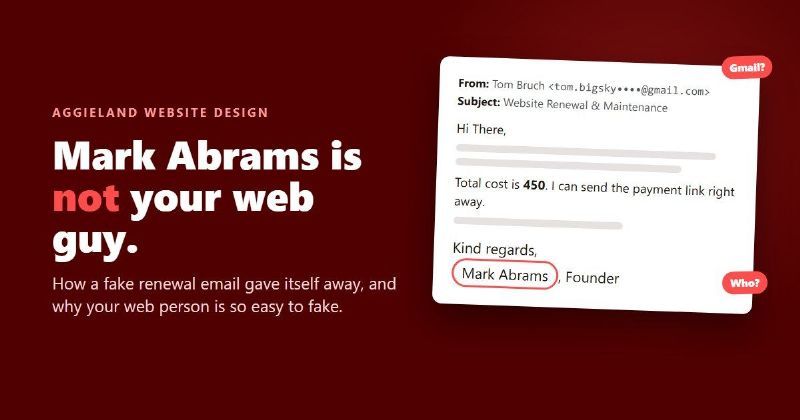
I know because somebody pretended to be me. On September 17, 2026, at 3:28 in the morning, an email went out to some of our clients with my name at the top, our real Big Sky logo and a link to our real About page, and I'll be honest, it looked pretty legit.
It said I'd taken a closer look at their website, was "genuinely impressed" with how it was built, and wanted to warn them that their domain and a bunch of their plugins were coming up for renewal. Total cost, $450, and I'd be glad to send over a payment link and get right on it.
We reported it to Google that morning and they shut the account down the same day. But it was a good fake, so it's worth walking through how it gave itself away.
How could you tell it wasn't really me?
Clue #1: It was signed "Mark Abrams." The top said Tom Bruch and the bottom said Mark Abrams, Founder. I have never once been Mark Abrams (although the picture next to his name really was me, probably grabbed right off our website).
Clue #2: It came from a Gmail address. The name on an email is whatever the sender types in, so the address next to it is the part that counts. This one was a Gmail account made to look close to ours. My real addresses are at aggielandwebsitedesign.com, bigskyinternetdesign.com and excelerationdesigns.com, and I never send business email from a Gmail account. But at a quick glance, it looked real.
Clue #3: It wanted money for themes and plugins. That's WordPress language. We don't build on WordPress, so there was nothing like that to renew. From the scammer's side it was a safe bet, since millions of small business websites do run on WordPress.
Clue #4: It said "Hi There" and it was in a hurry. I'd use your name. And a real renewal never needs to be paid tonight before something bad happens.
Why does this work so well on small businesses?
Think about how website stuff usually gets bought. The domain got registered years ago, maybe by a nephew. The hosting renews on a card nobody looks at, and the email might be through a third company altogether. Nobody has the whole picture in one place, so when an email says "your domain is up for renewal," there's nothing to check it against.
That's the gap. The scammer doesn't have to know a thing about your business, they just have to sound like somebody you probably pay. And scammers are not dumb. They send out thousands of these, so the numbers are in their favor.
Can you count on catching the next one?
Not by its mistakes. The next one will probably be signed with the right name and come from an address that looks even closer to the real thing.
What actually protects you is a habit. If an email asks for money and anything about it feels even a little off, call the company at a number you already have, never the one in the email. Or start a brand new email to the address you've always used for them.
For our own clients it's simpler than that. For most of them we take care of the domain, the website and the hosting all in one place, and for a lot of them email too. So if anybody but us emails you about renewing any of it, it's fake. Plus we renew it all for them, so they don't have to worry about any of it.
Frequently asked questions
Do real web designers send renewal notices?
Some do, usually for domain names. A real one comes from the address you already know and matches an invoice or account you recognize.
Why would a scammer use a real company's logo and photos?
Because it's free. Logos and staff photos sit right there on public websites, and copying them takes seconds. A familiar logo proves nothing about who sent the email.
What should I do if I got one of these?
Don't reply and don't click anything in it. Mark it as spam or phishing, delete it, and let the real company know so they can warn everybody else.
What if I already paid it?
Call your bank or card company today, then call the real company. The sooner they both know, the better your chances.
Let's talk
If an email about your website ever doesn't feel right, call me at 979-217-1544 before you do anything with it.
Tom Bruch has built websites since 1998 and is the owner of Aggieland Website Design.